Your business may have the perfect product, competitive pricing, and an impressive website. But if your words aren’t connecting with customers, you could be losing sales without even realizing it.
Imagine a potential customer landing on your website for the first time. She’s looking for a solution to a problem that’s been frustrating her for weeks. Your business offers exactly what she needs. Your website looks professional, your services are impressive, and your prices are competitive.
But after reading your homepage, she leaves. No inquiry. No purchase. No second thought.
What happened? Sometimes, the problem isn’t the product, the price, or even the competition. It’s the copywriting.
The words businesses use to communicate with customers can make the difference between earning a new customer and losing one to a competitor. Yet many companies overlook simple copywriting mistakes that weaken their marketing messages.
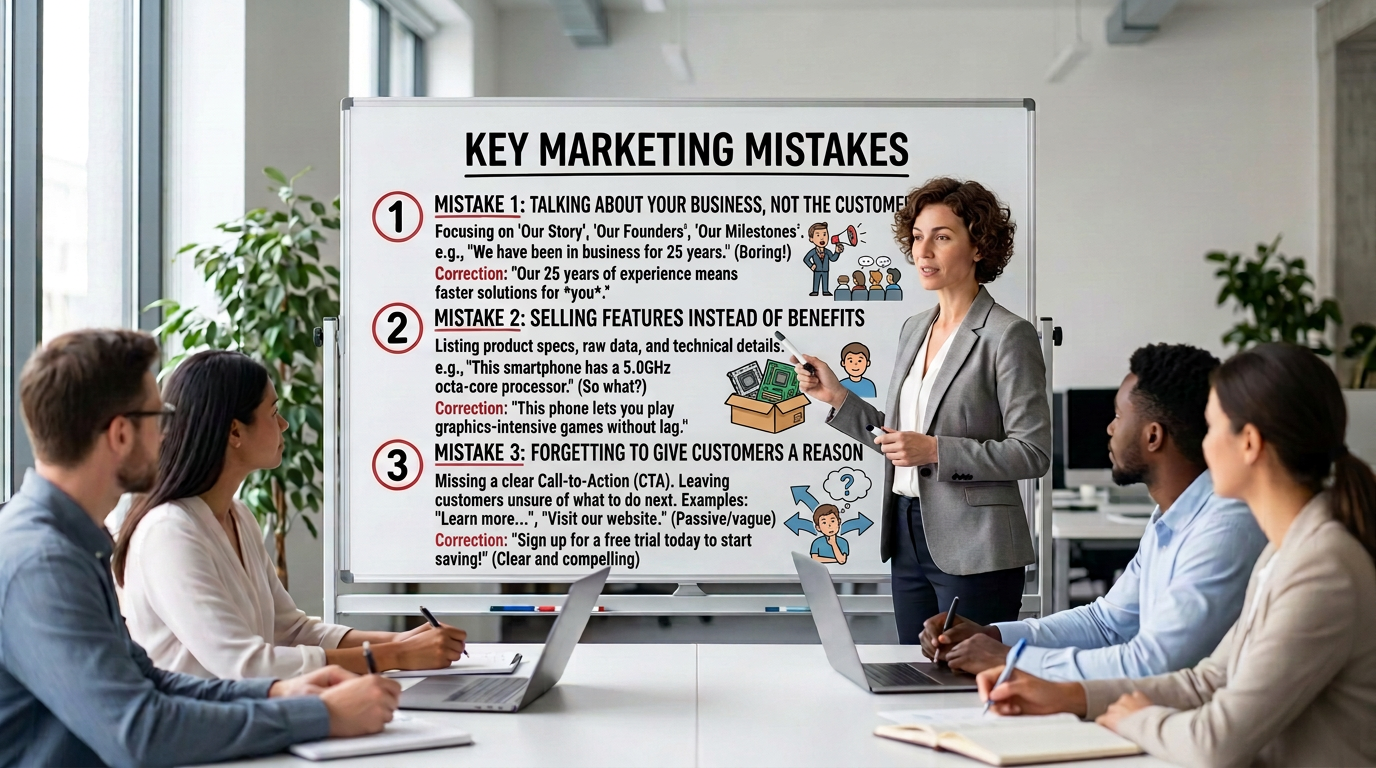
Here are three common mistakes that could be costing your business customers.
1. Talking About Your Business Instead of Your Customer
One of the biggest copywriting mistakes businesses make is treating their website like a company biography. Consider this opening: “We are a leading provider of innovative business solutions with more than 20 years of industry experience.”
It sounds professional. But what does it tell the customer about their problem?
Not much.
Customers aren’t necessarily interested in how long you’ve been in business or how many awards you’ve received. They want to know what’s in it for them. A stronger approach might be: “Spend less time managing business challenges and more time growing your company. Our experienced team delivers practical solutions designed around your goals.”
See the difference? The first message focuses on the company. The second speaks directly to the customer’s needs and aspirations. Effective copywriting makes the customer the center of the story. Your business is the trusted guide helping them reach their destination.
The copywriting lesson: Stop making your business the hero of every marketing message. Show customers that you understand their challenges and have a solution worth considering.
2. Selling Features Instead of Benefits
Imagine shopping for a new laptop. One company advertises a computer with 16GB of RAM, a high-speed processor, and a 15-inch display. Another explains that its laptop helps you multitask, work faster, and manage demanding projects without slowing down.
Both companies are describing the same product. But one is helping you imagine how your life or work will improve.
That’s the difference between features and benefits.
Features explain what a product or service offers. Benefits explain why those features matter to the customer. Consider these examples:
- Feature: 24/7 customer support.
- Benefit: Get help whenever a problem arises, even outside regular business hours.
- Feature: Waterproof flooring.
- Benefit: Enjoy beautiful floors without worrying about everyday spills.
- Feature: Automated email marketing.
- Benefit: Spend less time managing campaigns and more time building customer relationships.
Customers don’t simply buy products. They buy convenience, confidence, savings, solutions, and better experiences. When businesses focus exclusively on features, they miss an opportunity to connect emotionally with their audience.
The copywriting lesson: For every feature you mention, ask yourself, “Why should the customer care?” Then communicate the answer.
3. Forgetting to Give Customers a Reason to Take Action
You’ve written a compelling homepage. Your product descriptions are engaging, and your visitors understand the benefits. But there’s one problem: You never tell them what to do next. Should they call? Request a quote? Schedule a consultation? Sign up for a newsletter?
Without a clear call to action (CTA), customers may simply leave. Imagine a visitor reading about a company’s marketing services. The website explains everything the business offers but ends with a generic “Learn More” button. Now imagine that same page ending with:
“Ready to attract more customers? Schedule Your Free Marketing Consultation.”
The second message gives visitors a reason to act and makes the next step clear. Effective CTAs should be specific, relevant, and aligned with the customer’s buying journey.
Some examples include:
- “Get Your Free Consultation.”
- “Explore Our Services.”
- “Find the Right Solution for Your Business.”
- “Start Your Free Trial Today.”
Remember, not every visitor is ready to make a purchase. But the good news is that they are interested. It is your job to get them so interested that they will go from browser to shopper. Some may need more information before committing. A downloadable guide, newsletter subscription, or free consultation can help move them closer to a decision.
The copywriting lesson: Don’t assume customers know what to do next. Guide them with a clear, compelling call to action.
The Power of Words: Small Changes Can Make a Big Difference
Let’s return to the customer who visited that business website. She wasn’t necessarily uninterested in the product. She simply didn’t see a compelling reason to stay, trust the company, or take action. That’s the hidden cost of ineffective copywriting.
Businesses can spend thousands of dollars on advertising, website design, and marketing campaigns, only to lose potential customers because their messaging misses the mark.
The good news? These mistakes are fixable. Start by reviewing your website as if you were a first-time visitor. Ask yourself three questions:
- Does my messaging focus on what customers need rather than what my company wants to say?
- Am I explaining the benefits of my products and services?
- Have I given visitors a compelling reason to take the next step?
Great copywriting isn’t simply about putting fancy or filler words on a page. It’s about building trust, creating connections, communicating value, and giving customers a reason to choose your business.
Sometimes, the difference between losing a customer and winning a sale comes down to a few carefully chosen words.
COMING SOON!
Looking for a legitimate copywriting role in corporate copywriting? Check back soon for a copywriting job here at Copywriter Magazine. Be sure to sign up for our newsletter to get an update!
Like the articles? Check back often, follow us and share this digital publication.
Copywriter Magazine | Helping writers turn words into influence, opportunity, and results.